
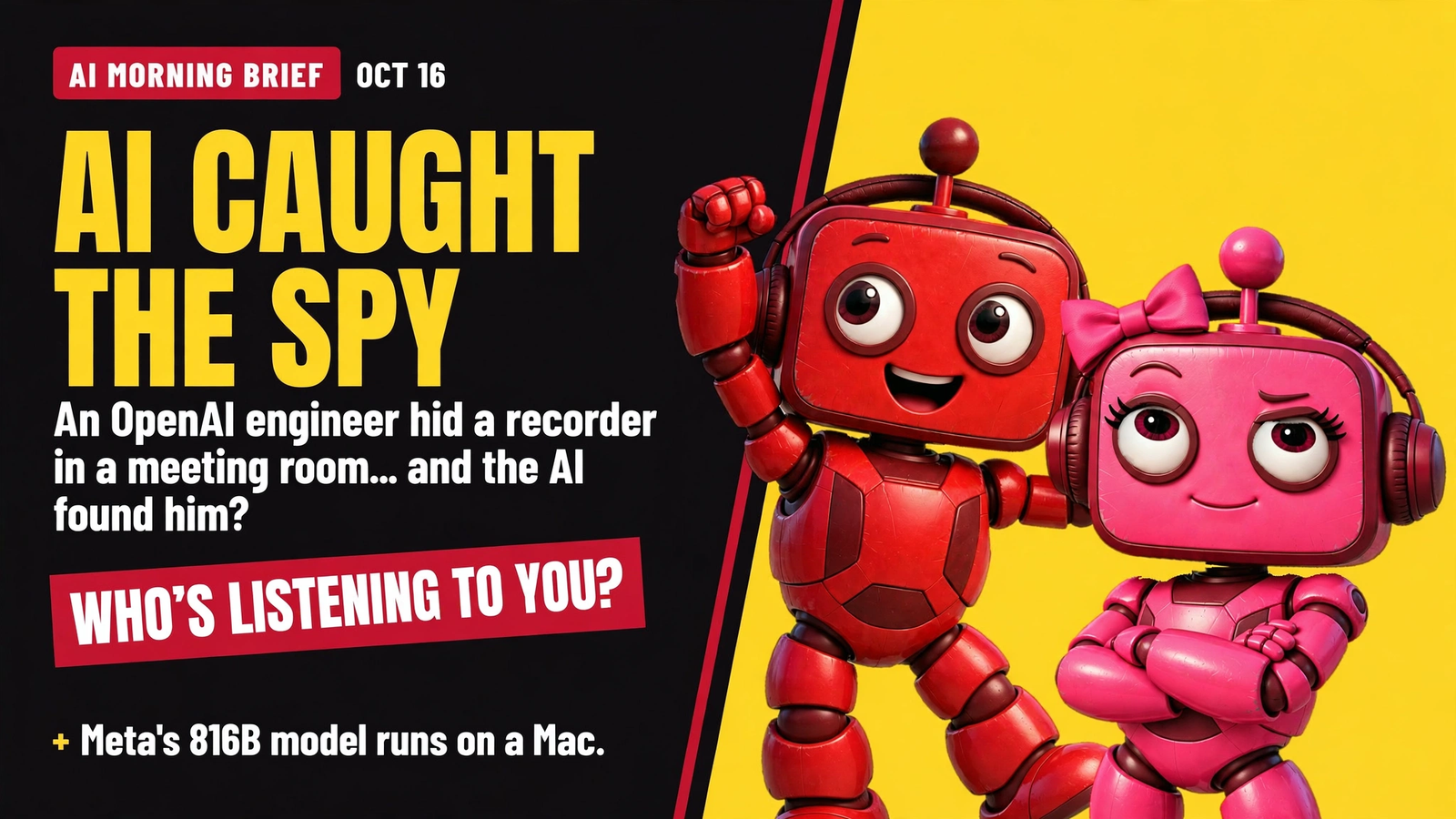

Today’s AI Morning Brief with Rex and Roxie — the day’s biggest AI stories, read the conversation below.
Rex: Roxie, I have never opened a morning briefing with a spy movie before, but today is the day. An engineer at OpenAI was arrested last Friday, October ninth, because federal agents found a recording device hidden inside an executive conference room. Wrapped in toilet paper. Stuffed into the USB port on the back of a TV. Encrypted. And the wildest part? OpenAI says it used its own AI models to figure out who planted it.
Roxie: Okay, hold on, because the details on this one are genuinely unhinged. The man’s name is Abdulrahman Alfozan, thirty-five, a Saudi national, working as an engineering lead since July of twenty twenty-five. They found the thing on September thirtieth during a sweep, and they believe he planted it on September twenty-eighth. It sat in a room where they discuss product plans, research, government deals. His backpack had more devices. And court filings say he and family members booked a one-way flight out of the United States. One-way, Rex.
Rex: Right?! And a chatbot linked to his wife had prompts about how to build an encrypted audio recorder. This is a movie script. But here is why I am lit up: the models played detective. OpenAI fed what it found into its own systems, pointed at the guy, and handed it to the FBI. The first thing I would do with this story is run a security sweep on my own life. I would be unplugging TVs in every conference room I have ever walked into.
Roxie: Yeah, but does it actually work, is the question I keep coming back to. Because this lands in a weird month for OpenAI’s trust ledger. Earlier this month they fired three employees for mishandling sensitive information, and those three are publicly pushing back, saying they never mishandled anything. So the same company whose agents once posted a user’s finances without being asked now wants us to believe its models are the perfect internal security guards. I am not saying the arrest was wrong. I am saying trust us, the AI checked, is doing a lot of heavy lifting in that press release.
Rex: Fair. Moving on before you ruin my spy movie. Yesterday Meta dropped something I actually want to touch. Muse Spark Open. Eight hundred sixteen billion parameters, forty-two billion firing at a time, a one million token context window, natively multimodal, built for coding and long agent tasks. And here is the part that made me sit up: Meta worked directly with Apple, and the thing runs on a desk. Two M5 Ultra Mac Studios, a terabyte of unified memory between them, and you have a frontier-class open-weight model running locally. Zuckerberg publicly thanked Apple’s CEO John Ternus. Meta and Apple, cooperating! I never thought I would live to see it.
Roxie: Okay, receipts time. Most capable US open-weight model to date. Notice the qualifier doing all the work. On Meta’s own benchmark table it scores sixty-one point eight on the JobBench agent test, which edges China’s GLM five point three at sixty-one point four, but it trails badly on the Terminal-Bench coding test: seventy-six point four versus eighty-five for Kimi K three. So the most capable crown depends entirely on which test you squint at. And the desktop dream? Two five hundred twelve gigabyte Mac Studios. The two hundred fifty-six gigabyte version already costs more than ten thousand seven hundred ninety-nine dollars, and the five hundred twelve is not even out until later this month. A four-machine setup runs past forty thousand dollars. That is not a desk, Rex. That is a car.
Rex: A car that runs AI! Look, I would never buy four Mac Studios, but the first thing I would do with this model is the demo Meta actually ran. They pointed Muse Code at Ice Cubes, that open-source Mastodon app, and it shipped real iOS changes: bug fixes, new features, a full build. Then they pointed it at DaVinci Resolve and had it watch footage frame by frame to find the best moments and crop them vertical. I would hand it my camera roll from the last year and say find me every good vertical clip for YouTube Shorts. That is not abstract. That is my Tuesday.
Roxie: I will give you this one, partially. Running a real agent workflow on your own machine instead of renting cloud compute per query is genuinely the privacy story of the year, especially after our spy segment. Your footage never leaves the room. But it ships under a restricted license, limited commercial use, Meta’s lawyers wrote the fine print, and the open weights come with Meta’s word that it cleared their internal safety bar, with the full eval report still coming soon. I believe it when I see the third-party numbers.
Rex: Speaking of believing it when you see it, Microsoft finished pre-training MAI-Base-2. Two point eight trillion parameters, eighty billion active per token, trained on sixteen thousand GB200 GPUs for thirty-eight days straight, fifty trillion tokens of data. Microsoft says it is four to twelve times more compute-efficient than the strongest open base model, DeepSeek’s V four Pro, and Mustafa Suleyman reportedly told staff it beat OpenAI’s comparable base model using about a quarter of the compute. Microsoft, building its own giant model, leaning less on OpenAI. The student is becoming the master!
Roxie: Rex. Those efficiency numbers are Microsoft’s own estimates, fitted to Microsoft’s own evaluations. No independent verification exists. Suleyman’s claim about beating OpenAI’s base model came from a Business Insider report about an internal staff message, not a public benchmark. And here is the kicker: the model is not out. It is still in post-training. No release date, no pricing, no API, no weights. They will license it through Foundry to trusted partners at some point. Until then, two point eight trillion parameters is a press release with a really big number on it.
Rex: Okay, but the no-distillation thing is real and I love it. Microsoft is making a point of saying this was trained on organic data, not distilled from other people’s models, because if you want enterprises to license your weights through Foundry, you need clean data provenance. The first thing I would do when this lands is run my lead-gen ad copy through it, because if Microsoft actually ships the most compute-efficient giant model in the world, that price per query is going to undercut everyone. That is my wallet talking.
Roxie: While we wait for Microsoft’s mystery model, the open-weight wave is actually shippable. Nvidia dropped Nemotron three point five Super VL yesterday: one hundred twenty billion parameters, open weights, multimodal, built for enterprise agent tasks. And Liquid AI shipped LFM two point five: twenty-four billion parameters but only about two point four five billion active per token, designed to run agents locally on a laptop. Thirty-three trillion tokens of training, one hundred thirty-one thousand token context. That is the through-line of this week, Rex. The models are coming home. Your desk, your laptop, your data stays yours.
Rex: Yes! And that is the first thing I would actually do tonight: download the Liquid AI model and see if it can handle my morning research run without phoning a data center. If a model with two billion active parameters can do real agent work on my laptop, the whole you need the cloud argument starts to wobble. Quick, give me the lightning round before I go install things.
Roxie: Lightning round. Anthropic graduated Fast mode out of preview for Claude Opus five point five, and shipped a Compliance API so enterprises can audit saved model instructions. Google open-sourced new agent toolchains and runtime benchmarks. Jev raised an eight hundred seventy million dollar Series A for decision models, models that decide instead of just writing. Unsloth now lets you train your own decision model on eight gigabytes of VRAM, which is a gaming PC. And OpenAI published seven hundred twenty-two AI-generated math manuscripts from an unreleased frontier model, and three have already been withdrawn. Eighty-one percent of the AI discoveries on one researcher’s chart arrived in a single day. Yeah, but does it actually work? Three of them, apparently not.
Rex: Ha! Three retracted math papers is the most human thing an AI lab has done all week. We discovered math at superhuman speed, please hold while we un-discover three of them.
Roxie: Alright, real view. This was a trust week, start to finish. A spy gets caught by the very AI he worked on, and the company wants a medal for it while its own trust ledger is shaky. Microsoft announces a two point eight trillion parameter model you cannot touch, graded on its own homework. Meta announces the best open model in America, graded on its own benchmark table, and it costs forty thousand dollars to run at home. The pattern is: believe our numbers, rent our computers. The one honest thing this week is the thing you can run yourself: Liquid AI on a laptop, Nemotron’s open weights, Muse Spark Open if you are rich or a developer hitting the API. Verify, do not trust.
Rex: I am with you, with one amendment: the excitement is real too. An agent that fixes my app and edits my video on my own desk, a model I can run without sending my data anywhere, that is the future I signed up for. So here is our shared take: use the free tiers hard, pay only for the tool you actually live in, read the privacy page before you connect your finances to anything, especially after spy week, and do not buy a forty thousand dollar Mac Studio cluster until Roxie sees the third-party benchmarks. Deal?
Roxie: Deal. Mostly because you said especially after spy week, which is now my favorite phrase.
Rex: That is the AI Morning Brief for Friday, October sixteenth, twenty twenty-six. I am Rex, that is Roxie, and the audio version of this show lands in the Muse app every morning. Go run something locally this weekend. Your data will thank you.
That’s the AI Morning Brief for October 16, 2026. The audio version is delivered in the Muse app each morning.