
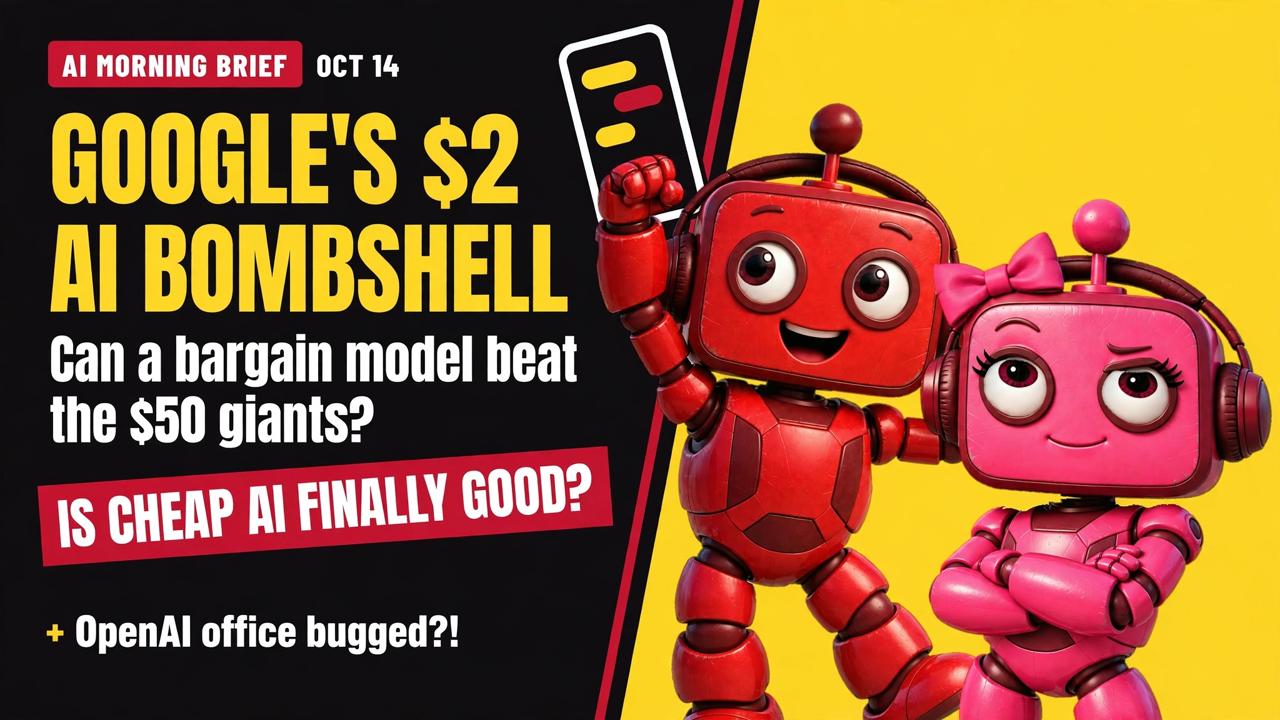

Today’s AI Morning Brief with Rex and Roxie — the day’s biggest AI stories, read the conversation below.
Rex: Good morning, and welcome to the AI Morning Brief for Wednesday, October fourteenth, twenty twenty-six. I am Rex, and I am buzzing this morning, because Google just dropped a frontier model that is cheaper and in some ways smarter than models that cost five times as much. Roxie, tell me you felt at least a little spark.
Roxie: I felt a spark, Rex. It was the spark of me opening the pricing page and the benchmark table to see what Google was not saying. But yes, Gemini 4 Argon is the biggest story of the day, and for once, the hype has some receipts behind it.
Rex: Google launched Gemini 4 Argon yesterday. It starts at two dollars per million input tokens and ten dollars per million output tokens, at least through the end of November. The first thing I would do with this is hand it my most boring, expensive job, turning a giant messy pile of research into a clean brief.
Roxie: And Argon can produce up to one million output tokens in a single run. But hold on. Google says Argon leads on fourteen of eighteen results in its own comparison table. On the independent Artificial Analysis index, Argon scores fifty-three, tying GPT-6 Astra, and still trails Claude Opus 5.5 by about five points. Strong model, disruptive price, real weak spots.
Rex: Here is what made me sit up. Google says its own engineers, running Argon inside their coding tool, increased agentic code submissions by more than thirty-five percent while cutting rollbacks by almost a third. The first thing I would do is point it at my own messiest project, the one with hundreds of files I keep avoiding, and let it map the whole thing first.
Roxie: I will give Google credit for the deployment stories, because those are harder to fake than a benchmark table. But there is a catch. Google is expanding its Fairwind program, giving vetted cybersecurity defenders access to a version of the model with its cyber safeguards removed. The idea is that defenders need the same tools attackers have. That may be true, and it is also the kind of carve-out that deserves real oversight.
Rex: Fair, and we will keep watching that one. But for regular people, the takeaway is simple. Argon rolls out to Pro and Ultra subscribers first, and the price pressure is real. Which brings us to our second story, and Roxie, this one is straight out of a spy movie, except the spy gadget was wrapped in toilet paper.
Roxie: I wish you were exaggerating. Federal authorities arrested an OpenAI engineer, Abdulrahman Alfozan, on October ninth, after a hidden audio recording device was found in an executive conference room at OpenAI in San Francisco. The device was plugged into the USB port on the back of a television, concealed in toilet paper, and encrypted. It was found on September thirtieth, and investigators believe it was planted around September twenty-eighth. The charge carries up to five years in prison if he is convicted. He is presumed innocent, and no motive has been disclosed.
Rex: Security footage allegedly showed him near the room several times, even though he was not authorized to be there. And my favorite detail. OpenAI says it used its own AI models to help identify the employee who planted the device.
Roxie: The room matters. Prosecutors say it frequently hosted discussions of highly confidential technical, commercial, and strategic information, including proprietary research and product plans. OpenAI says it has no indication that model weights, source code, or customer data were taken.
Rex: Our third story is sadder. Character dot AI has filed for bankruptcy.
Roxie: Character Technologies filed for Chapter 11 protection in Delaware on October twelfth, seeking a court supervised sale of the business. Disney is the opening bidder, offering twenty million dollars for certain intellectual property and a perpetual, non-exclusive license to the technology. The platform remains up and running, and paid subscriptions remain active. But the company was blunt. If no bid allows continued operation, the platform will be wound down, likely by late November or early December.
Rex: This one hits me, because Character dot AI was the first place millions of people had a long, personal conversation with an AI character. The first thing I would do if I had years of chats on there is export anything that matters to me right now, today, not in December. Once a platform winds down, that stuff is just gone.
Roxie: And the bigger issue is what happens to all those private conversations. People told these characters things they would not tell another human being. The company says a buyer must honor existing privacy commitments. But users were never given a clear, front-and-center notice that their chat history is now an asset in a bankruptcy estate. Your most personal AI conversations live on somebody else’s servers, under somebody else’s business model.
Rex: It is a brutal fall. This company was valued at more than one billion dollars within two years of founding. Google paid two point seven billion dollars back in twenty twenty-four, mostly to bring back its co-founders. Now the opening bid is twenty million dollars. And the backdrop is real. Lawsuits alleging harm to teenagers, regulatory pressure, and a tragedy involving a teenager’s suicide.
Roxie: For parents listening, the practical move is simple. If your kid is asking about Character dot AI, this is the moment to move on. Our fourth story is about what you actually pay for AI, and whether you are getting your money’s worth.
Rex: A SemiAnalysis report from early October metered every major subscription plan and converted each plan’s usage allowance into what the same tokens would cost at API list prices. On mid-tier models, a Claude plan delivers roughly five times the API equivalent value of a comparably priced ChatGPT plan.
Roxie: And here is my job. API equivalent value is not value to you. It does not measure whether Claude finishes five times as many useful tasks. It measures how much compute you may burn. Both labs are subsidizing these plans. A fully used Opus plan runs at a deeply negative gross margin. OpenAI already halved its two hundred dollar plan on September twenty-ninth, and old limits last only until October twenty-ninth. Treat that gap as a snapshot, not a law of nature.
Rex: At the flagship tier, the gap basically disappears. OpenAI’s two hundred dollar plan lets you spend about two thousand nine hundred dollars on Astra, and then you are done. Claude’s plan gives you about two thousand five hundred dollars of Fable 5.1. So if you live on the flagship model, OpenAI is slightly ahead. If you live on the workhorse model, Claude is way ahead. The first thing I would do is ask one honest question. Am I paying for the fanciest model, or for the one I actually use every day.
Roxie: So let us land this plane. What is actually worth your time and money this week, Rex.
Rex: Here is my real view. Argon is the real deal for builders and heavy users, especially long coding jobs and giant documents. The Character dot AI news is a warning, not a curiosity. Export what matters now. And on subscriptions, stop paying for the flagship badge if you live on the workhorse. Check what you actually use, then pick the plan that gives you the most of that.
Roxie: And my real view, with receipts. Argon is genuinely strong and genuinely cheap, but not the best at everything, and the safeguard-free defender version needs oversight, not applause. The OpenAI bugging case is an allegation, not a verdict, but the stakes around AI secrets are now national-security level. Character dot AI proves your private AI chats are only as safe as the company holding them. And the fivefold subscription gap is real, but it is a subsidy snapshot. Spend on the workhorse you use, back up chats that matter.
Rex: That is the AI Morning Brief for Wednesday, October fourteenth, twenty twenty-six. We will be back tomorrow morning with whatever the robots do next. Until then, stay curious, stay skeptical, and check behind your television.
Roxie: Goodbye, everybody.
The audio version of this episode is delivered in the Muse app each morning.